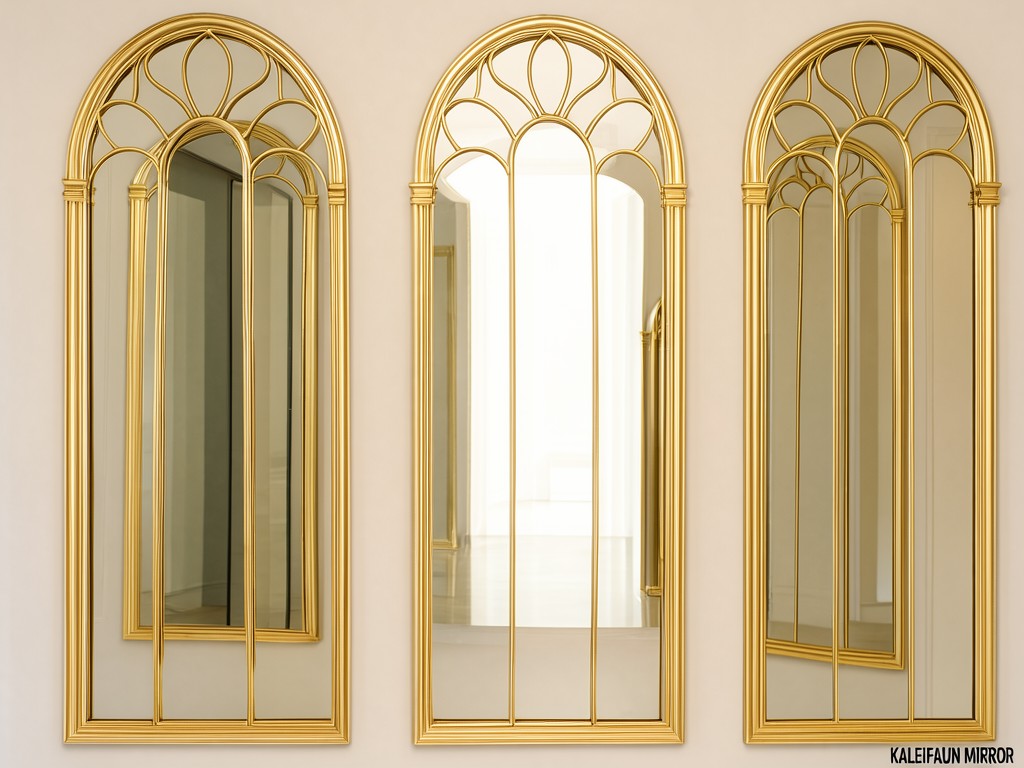
Specifying Custom full length gold arched wall mirrors Wholesale for Wholesale and OEM Orders
Selection rule: agree the glass thickness, frame material, gold finish reference, and mounting arrangement on one approved drawing and sample. A lighter aluminum frame reduces handling weight; a steel frame offers a firmer profile but adds mass and makes finish protection at cut edges more important.
Two suppliers quoting the same specification can still ship mirrors with different gold tones, arch proportions, or assembled weights. For distributors qualifying a second source, lock those visible and measurable details before comparing unit price. A signed drawing and retained finish sample give both factories a clear basis for production approval and reorder checks.
Material Options and Their Trade-offs
The mirror panel is commonly made from float glass with a reflective silver layer and protective backing paint. Glass thickness affects weight, handling, and the finished assembly cost; the correct choice depends on mirror size and the support design. A safety backing film can help retain fragments if glass breaks, but it does not make the panel impact-proof.
Aluminum frames keep the unit lighter and suit a gold anodized or powder-coated finish. Steel frames add weight and can provide a stiffer perimeter, though coating coverage at joints and cut edges needs attention in humid rooms. Gold is a decorative finish, not an outdoor weatherproofing specification; standing water and prolonged damp exposure can damage frame coatings or backing paint at exposed edges.
| Finish and colour option | Typical frame route | Approval point |
|---|---|---|
| Champagne gold | Gold anodizing on compatible aluminum, or a colour-matched powder coat | Approve the physical sample under agreed lighting; digital colour values alone do not settle the appearance. |
| Satin gold | Powder-coated aluminum or steel | Record sheen and texture alongside the shade reference. |
| Bright gold | Powder-coated frame; availability depends on the selected profile and supplier finish system | Check reflected light and visible surface marks on the full-size sample. |
Comparing Two Standard Configurations
Unit price settles the question only after the frame profile, finish route, and packed dimensions are held constant. The following configurations are useful starting points for quotations; final weight and cost depend on the arch size, glass thickness, and mounting hardware.
Lightweight Aluminum Frame
A narrow aluminum profile reduces carry and installation weight, which can help distributors manage larger carton quantities. Confirm the profile depth and rear fixing points on the drawing; a slim front edge should not be mistaken for a complete wall-support specification. Gold anodizing is limited to compatible aluminum finishes, while powder coating allows a broader colour match.
Steel Frame
Steel adds mass and can support a more substantial frame profile. Its coating needs even coverage around corners, seams, and fixing points, particularly for mirrors sold into bathrooms or other humid interiors. The added weight also affects carton handling and wall-fixing requirements, so confirm both before artwork and packaging are released.
| Nominal mirror size | Glass thickness range | Indicative assembled net weight |
|---|---|---|
| 1500 × 500 mm | 3–4 mm | Approximately 9–13 kg |
| 1600 × 600 mm | 3–4 mm | Approximately 11–16 kg |
| 1800 × 700 mm | 3–4 mm | Approximately 15–21 kg |
These are planning ranges, not a substitute for a production drawing. A thicker glass panel, steel frame, or larger rear hardware set can move the finished weight above the range; confirm the approved sample before setting carton limits or freight calculations.
What Can Be Customised and What Cannot
Custom orders can set overall height and width, arch radius, frame width and depth, glass thickness, gold shade, backing film, and rear mounting hardware. Private-label buyers can also specify carton graphics, labels, barcode placement, and packing quantities. Provide dimensioned artwork or a drawing that identifies the front view, side profile, mounting points, and any required logo position.
Approval boundary: glass reflection, finish shade, and frame geometry must be assessed on physical samples. A drawing can define dimensions and tolerances, but it cannot fully represent reflected appearance or the way a gold finish reads under retail lighting.
Before mass production, align the drawing revision, approved sample, finish reference, carton artwork, and inspection points. Tolerances for overall dimensions, arch symmetry, and fixing-hole locations should be written into the drawing after the factory confirms the selected process. Do not assume that a custom curve or profile is included in a standard frame price; non-standard tooling or fabrication can affect minimum order quantity and lead time.
How Consistency Is Held Across Batches
Unit price and service life diverge when a second source changes glass, backing, or frame finish without recording the change. For repeat orders, retain the approved sample and drawing revision as the comparison baseline. The factory can check incoming glass thickness and panel dimensions, then inspect cut edges, the reflective surface, frame fit, and mounting locations during assembly.
Batch checks should compare the gold finish against the retained reference under agreed lighting and note visible shade or sheen variation. Inspect the backing for exposed silvering, paint gaps, and damage at the perimeter; inspect the frame for coating misses, scratches, and loose joints. Any acceptance limits for dimensions, appearance, or weight belong in the purchase specification rather than in an informal sample comment.
For a second-source qualification, request a pre-production sample in the intended retail configuration, including the final mounting hardware and export carton. Approve the packed unit before the order moves to volume production, and keep batch identification on cartons or accompanying records so a finish or fit issue can be traced to the shipment.
Care, Storage and Service Life
These mirrors are intended for indoor use. In bathrooms or humid interiors, ventilation and dry frame joints matter; water left at the lower edge can reach the backing or coating and start deterioration. Avoid direct outdoor exposure unless the materials and finish have been specified and approved for that condition.
Use a soft cloth and a suitable glass cleaner on the reflective face, then dry the edges. Keep abrasive pads and excess liquid away from the frame joints and rear backing. During storage, hold cartons upright in a dry area, protect the corners, and prevent cartons from leaning against sharp or uneven surfaces. Follow the approved carton orientation and stacking limits for the shipment.
Service life depends on installation support, room conditions, edge protection, and handling after delivery. Confirm the wall fixing method for the finished unit weight and the wall type; the supplied mirror hardware should not replace a site-specific check of the wall and anchors.
Discuss a Second-Source Project
Share your target dimensions, frame material, gold finish reference, expected order volume, and destination market. We can review the drawing and sample-approval sequence before quotation, then confirm the production and export-packaging details for your wholesale or OEM order.