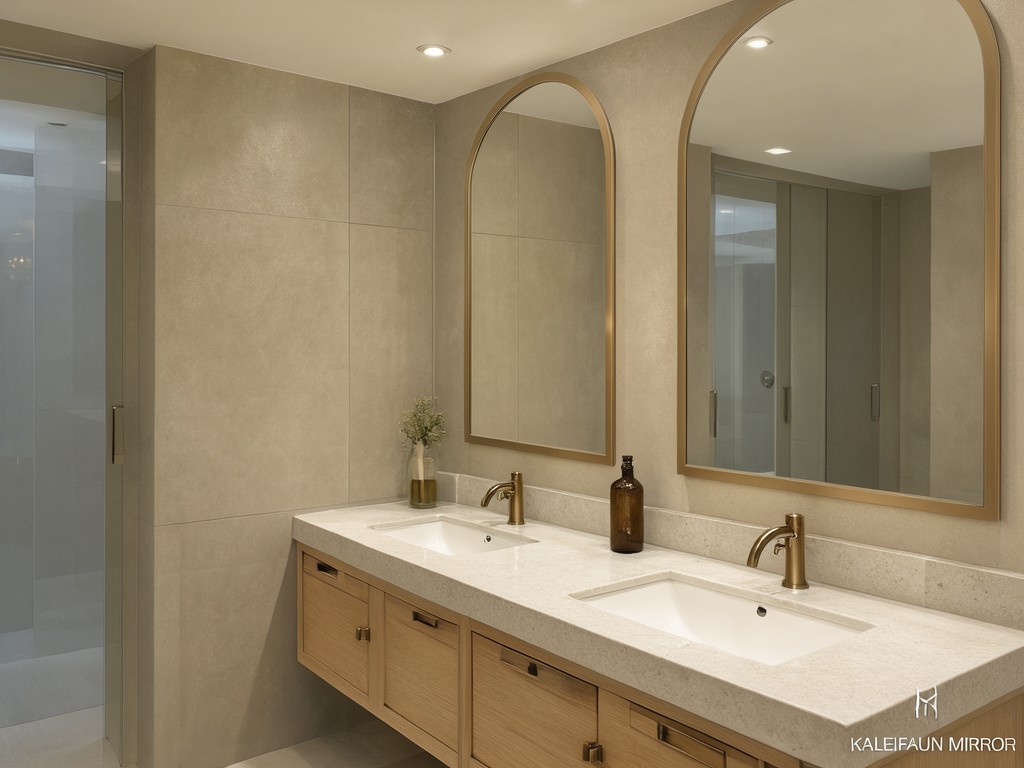
Specifying wholesale arched bathroom vanity wall mirrors suppliers for Wholesale and OEM Orders
Repeat loading drives the failure: a mirror that shifts against its wall fixings can develop stress at the mounting points or chip along an exposed edge. In bathroom use, that risk combines with humid air and repeated cleaning; the right glass thickness, edge finish, backing and hanger layout depend on the intended size and installation.
For private-label and OEM buyers qualifying a second source, compare the mirror as a complete assembly rather than a glass panel alone. Confirm the arch profile, frame or frameless edge, rear protection and mounting method against the approved sample before setting reorder tolerances.
Glass Build
Common options are 4 mm or 5 mm mirror glass; larger panels may call for 6 mm, subject to size, support and weight limits.
Shape Control
Specify overall width, height, arch radius or profile drawing, and the location of the straight lower edge.
Installation
Choose rear brackets, a hanging rail or another agreed fixing system to suit the mirror weight and wall type.
Scope of Supply and Physical Form
Supply can include a cut-to-shape mirror panel, a metal or wood frame, rear safety film, mounting hardware, protective corner pieces and retail packaging. A frameless profile places more attention on edge polish and coating protection; a framed version conceals more of the edge but adds weight, cost and another finish to control.
Agree the reference dimensions from the outermost frame points or the glass edge, not both. For repeat production, the approved drawing should show the arch transition, edge radius, bracket locations, cable or rail clearances and any logo or label position.
Materials and Construction Trade-offs
Fatigue appears at the stress concentration: a notch, poorly finished edge or rigidly constrained fixing can turn normal handling into a crack or chip. The glass is cut to the arch profile and its edges are finished before the reflective coating and protective backing are applied; frame and hanger details are then matched to the finished panel.
Silver-Coated Mirror
A silver reflective layer with protective backing is a common choice for clear, neutral reflection. Specify a bathroom-suitable backing system and protect the perimeter from standing water; edge exposure remains the area most vulnerable to moisture-related deterioration.
Aluminum-Coated Mirror
An aluminum reflective layer can suit cost-led programs, but its appearance may differ from the approved silver sample. Compare the actual reflection and backing finish before a material substitution, especially when adding a new supplier to an established range.
Specification rule: a thicker panel can reduce flex across a wide span, but it raises unit weight and the load on wall fixings. Select thickness and hanger capacity together, then retain both in the approved product specification.
Measured Performance in Real Use
Weight and stiffness trade off against each other. A larger mirror with thicker glass may feel less flexible during handling, but it also needs stronger packaging and fixings; confirm the finished unit weight rather than estimating from glass thickness alone.
The ranges below are planning estimates for finished units, not fixed catalog limits. Arch geometry, frame material, backing and hardware change both the panel area and net weight.
| Nominal Overall Size | Indicative Net Unit Weight | Typical Glass Choice |
|---|---|---|
| 400 × 600 mm | About 3–5 kg | 4 mm, depending on frame and fixing design |
| 600 × 800 mm | About 5–8 kg | 4 mm or 5 mm |
| 600 × 900 mm | About 6–9 kg | 4 mm or 5 mm |
| 750 × 1000 mm | About 9–13 kg | 5 mm or 6 mm, subject to fixing review |
Repeated wiping with a soft cloth is normal service; abrasive pads, strong alkaline cleaners and liquid trapped at the lower edge can wear finishes or reach the reflective backing. Direct sunlight can also expose frame and backing finishes to heat and UV over time. Chlorine and sweat are not ordinary vanity conditions, but they can matter in pool or fitness changing areas, where cleaning chemicals and frequent contact call for explicit finish and care requirements.
Assumptions Buyers Should Stop Making
A matching outer size does not prove that two sources will deliver the same mirror. Profile tolerance, edge treatment, coating, mounting position and packing all affect fit and serviceability. Record those details in the drawing and purchase specification rather than relying on a product photo.
- Do not assume a rear safety film makes the mirror impact-proof or removes the need for suitable wall anchors.
- Do not treat silver- and aluminum-coated mirrors as visually interchangeable; approve the intended reflective appearance.
- Do not specify only “arched.” Define the arch radius or provide a dimensioned profile that fixes the shoulder and crown geometry.
- Do not assume a carton that protects flat panels will protect a curved top. Packaging needs clearance at the crown, edge guards and restraint against movement.
Volume Planning and Lead Time
Tooling needs depend on how the arch is made. A standard cut profile may use existing production capability, while a dedicated frame section, unique radius, logo treatment or custom protective insert can add setup work and approval steps. Establish whether the quoted MOQ applies per size, finish, frame colour or combined order before comparing unit prices.
For a second-source qualification, allow time for drawing review, sample approval, packaging confirmation and production scheduling. Lead time starts from the agreed order conditions and approved specifications; it can change if glass, frame finishes or custom packaging require separate procurement.
Stock Availability and Reorder Planning
Stock status is specific to the size, glass type, frame finish and pack configuration. Standard glass may be available sooner than a nonstandard arch or a custom frame colour, while a stocked panel still needs the correct hardware and export packing to ship as a finished SKU.
For repeat orders, retain the approved drawing revision, finish reference, hardware positions, carton specification and unit-weight range. Batch identification on cartons helps buyers trace damage or finish variation to a delivery and compare it against the approved sample.
| Parameter | Common Options or Range | Buyer Decision |
|---|---|---|
| Glass thickness | Typically 4–6 mm | Balance panel stiffness, finished weight and fixing capacity. |
| Reflective coating | Silver or aluminum coating systems | Approve the visual appearance and backing protection for the use environment. |
| Edge and rear protection | Polished edge; optional rear safety film or specified backing | Set the exposed-edge condition and safe handling requirement. |
| Frame and mount | Frameless, metal frame or wood frame; brackets or rail | Match finish, wall type, hardware layout and finished unit load. |
Questions Buyers Ask Before Ordering
Can the same arch profile be repeated across several mirror sizes?
Yes, if the drawing defines whether the crown radius stays constant or scales with overall width. Confirm each size as a separate dimensioned profile so the shoulder height and lower straight section remain consistent in production.
What information is needed to review mounting hardware?
Provide the mirror dimensions, frame or frameless construction, finished weight target, intended wall type and preferred mounting method. Anchor selection usually depends on the installation surface and may need to remain the installer’s responsibility.
Can a second source match an existing private-label sample?
A sample and its drawing give the supplier a comparison target, but coating type, frame finish, edge detail and mounting positions must also be recorded. Approve a production sample before bulk release if the new source uses different materials or processes.
How should arched mirrors be packed for export?
The pack should hold the mirror clear of neighboring units, protect the crown and lower corners, and prevent movement during handling. Confirm carton dimensions, quantity per pack, labeling and pallet plan against the finished mirror size and destination requirements.
Review Tooling Before You Commit
Share your target profile, size range, material and finish preferences, mounting details, order volume and pack requirements for a tooling and specification review. This gives your OEM team a clear basis to qualify a second source and compare the approved build against future reorders.
Request a tooling review