Wholesale gold arch wall mirror custom size China Supplier - Bulk Supply and Specification Guide
Where Cheaper Alternatives Fall Short
A mirror that arrives with a loose frame, chipped corners or a finish that differs from the approved sample can hold up a retail launch. Weight and stiffness trade off against each other: larger glass needs adequate frame support, while an unnecessarily heavy assembly raises handling and freight costs.
Repeat loading drives the failure at wall fixings and frame joints when the mirror is lifted, repositioned or subjected to vibration in transit. Fatigue appears at the stress concentration, often around a bracket, weld or sharp frame junction. Agreeing the mounting layout and corner construction before the sample is approved gives the factory a clear basis for production.
| Use Condition | Complaint Seen on Arrival or in Use | Specification to Set Before Production |
|---|---|---|
| Large mirror mounted vertically in a bedroom or dressing area | Frame flex, uneven arch outline or movement at the wall fixing | Overall width and height, frame section, glass thickness, fixing position and intended wall type |
| Multiple units displayed together in a shop or hospitality project | Gold tone or arch profile varies between units or reorder batches | Finish sample, profile drawing, reference dimensions and written approval for acceptable variation |
| Palletised export shipment with mixed carton handling | Glass edge damage, rubbed finish or frame distortion after delivery | Carton orientation, edge and corner protection, inner restraint and pallet configuration |
What the Design Has to Balance
Set the size from the finished outside edge. A drawing should identify the mirror's overall height and width, arch radius or curve, frame face width, glass dimensions, fixing points and the datum used for each measurement. Without those references, a correct-looking sample can still differ from the buyer's retail planogram or installation layout.
Glass thickness, frame section and mirror dimensions work as one assembly. Thicker glass adds weight; a narrow or light frame may then flex during handling, while an oversized frame can change the intended appearance and increase freight volume. The appropriate combination depends on the finished size, mounting orientation and packaging plan rather than on a single thickness chosen in isolation.
A gold finish also needs a physical reference. Screen colours do not define the appearance of a reflective or metallic surface. Approve a finish sample against the buyer's lighting and nearby hardware, then record the selected finish and frame profile in the order file for repeat production.
Matching the Product to the Buyer's Need
For a launch with a fixed shelf or installation date, settle the product drawing and finish reference before confirming the production slot. A sample that changes after approval can require new material preparation, revised packaging dimensions or another round of sign-off.
For a Cost-Controlled Retail Range
Use an established frame profile and a finish already sampled by the supplier where the product dimensions allow. This can reduce setup changes and simplify replenishment, but it limits how far the silhouette or gold tone can depart from the existing reference.
For a Private-Label Signature Size
Specify the complete outline, frame section and mounting arrangement on a dimensioned drawing. A custom profile or forming method can add setup cost and approval time, but it gives the buyer closer control over the product's proportions and shelf identity.
Assumptions Buyers Should Stop Making
A stated custom size is not enough to release a mirror for manufacture. Buyers and suppliers need to agree whether the dimensions refer to the glass, the frame's outside edge or the hanging envelope. A small difference can affect the arch profile, carton size and installation clearance.
- Do not treat “gold” as a single colour. Select a physical finish sample and record its reference with the approved drawing.
- A wall fixing supplied with the mirror is not automatically suitable for every wall construction. Confirm the intended wall type and installation method before finalising the hardware.
- Safety backing can help retain fragments if glass breaks, but it does not make the mirror unbreakable. State whether backing is required and include it in the approved sample specification.
- A sample approval does not set dimensional tolerances by itself. Put the key measurement points and allowable variation on the drawing or purchase specification.
Customisation Options and Their Limits
Customisation can cover mirror dimensions, arch proportions, frame material and section, gold finish, backing, wall hardware, carton markings and private-label packaging. Each change should be captured in a controlled drawing or artwork file; verbal descriptions are difficult to apply consistently across a bulk order.
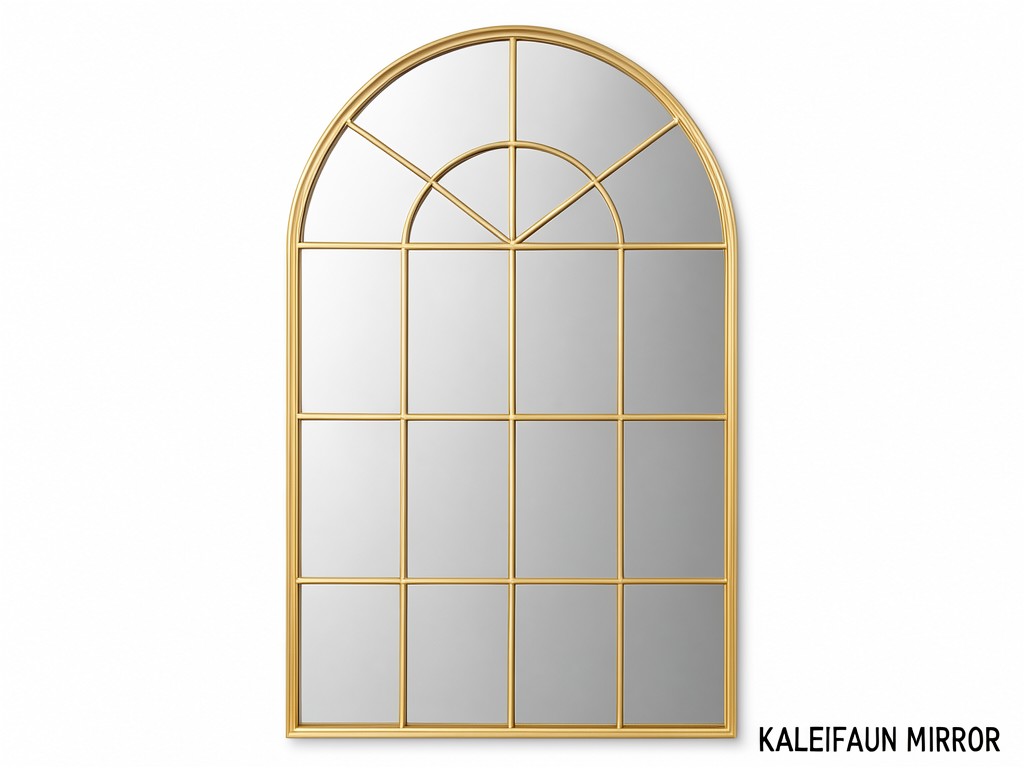
- Send a dimensioned drawing with units, front view, side detail, fixing locations and a clear indication of which edges define the finished size.
- Confirm the finish from a physical sample. A change in base metal or coating route may alter the gold appearance and the setup cost.
- Provide logo artwork as a production-ready file and identify its position, size and colour. Approve a packaging proof separately from the mirror finish.
- Treat non-standard profiles, special hardware and individually sized cartons as cost and schedule variables. The supplier can confirm feasibility after reviewing the drawing and order quantity.
The approved sample should represent the materials, frame construction, finish, backing and hardware planned for production. If any of those change after sign-off, request a revised sample or written approval of the proposed substitution before releasing the order.
Who Uses It and Where It Matters
Homeware brands use custom-size arch mirrors to build a coordinated bedroom or entryway collection. Their product managers typically need repeatable proportions across several sizes, with a finish and carton design that remain recognisable on replenishment orders.
Furniture and décor retailers may choose a larger format for dressing areas or full-length viewing. In that use, mounting hardware, product weight and the wall type need to be clear in the installation information; carton protection must also limit glass-edge contact during distribution handling.
Hotels, salons and other hospitality buyers often order multiple mirrors for rooms or customer-facing spaces. A consistent arch outline and gold tone matter across the installation, so the order should reference the signed sample and the same finish specification for every unit in the batch.
Capacity, Tooling and Scheduling
The production route depends on the frame profile and order volume. An established profile may avoid new profile tooling; a non-standard section or forming requirement can need tooling review and a sample stage before bulk release. Confirm the distinction in the quotation so the buyer can assess setup cost against the expected reorder volume.
| Order Stage | Planning Allowance | MOQ or Release Condition |
|---|---|---|
| Drawing review and sample approval | Allow time for drawing confirmation, material preparation and any requested sample revisions; the supplier should confirm the schedule after reviewing the design. | Sample scope and any tooling charge depend on whether the frame profile and finish are existing or custom. |
| First bulk production | A planning window of several weeks after final approval is common; confirm the committed date against material availability, order quantity and factory loading. | MOQ is quoted against dimensions, finish route, packaging and order mix rather than assumed from a standard mirror size. |
| Repeat order | A repeat can avoid some sample work if the approved specification and materials remain unchanged; production and freight dates still require reconfirmation. | Reference the prior drawing revision and finish approval. Changes to size, artwork or carton configuration can reset the schedule. |
For a fixed launch date, work backward from the required delivery point and include approval time, production, export packing and transit. A factory completion date is not the same as a delivery date at the buyer's warehouse.
Ordering, Tooling and Lead-Time Questions
Which dimensions should appear on the first drawing?
Show overall outside width and height, arch shape, frame face and depth, glass size, hanging points and the measurement datum. Add the intended orientation and note any tolerance that affects fit or visual alignment.
Does a custom arch require new tooling?
Not always. If the supplier can form the requested outline with an existing frame profile and process, separate profile tooling may not be needed. A new section or non-standard forming method can add setup cost and sample time; ask for a tooling assessment from the dimensioned drawing.
What is needed to approve the gold finish and private-label carton?
Approve a physical finish sample under representative lighting, then record it against the product drawing. Supply final logo artwork, placement and carton copy early enough for a separate packaging proof before bulk packing.
When is the production lead time confirmed?
The supplier can confirm a production schedule after the drawing, finish, sample, quantity and packaging details are settled. Revisions after approval may change the slot, so buyers with a fixed launch date should include a decision deadline and freight buffer in the order plan.
Review the Specification Before Booking Production
Send the target dimensions, finish reference, estimated quantity, packaging needs and required delivery window for a specification review. The review can identify open drawing, sample or tooling decisions before they affect the launch schedule.