Specifying Eco-friendly/Sustainable nature inspired organic wood wall mirror factory for Wholesale and OEM Orders
Replacement rate, not unit price, decides whether a wood wall mirror earns its shelf space. A low-priced frame can become expensive once corner damage, finish complaints, or a loose wall fitting leads to returns and replacement freight. For wholesale and retail buyers, the useful comparison is cost per unit sold across the season, not the factory quote alone.
Organic outlines add another cost variable: irregular curves need controlled templates, repeatable sanding, and packaging shaped to protect the widest points. A drawn, sculptural profile may use more frame stock and take longer to finish than a simple oval. Those costs make sense when the design holds its shape in transit and presents consistently from one reorder to the next.
Where Cheaper Alternatives Fall Short
| Complaint after delivery or sale | Likely design or packing weakness | Specification to review |
|---|---|---|
| Frame joints open or corners shift | A long curved profile puts stress on poorly matched joints, especially after repeated handling. | Agree the joint locations, assembly method, and profile drawing before bulk production. |
| Finish looks patchy or wears at the edge | Uneven sanding and coating coverage show most clearly on curved edges and end grain. | Set a reference sample for colour, sheen, edge coverage, and acceptable natural variation. |
| Mirror glass arrives cracked or chipped | The glass shifts in the frame or the carton leaves corners and projecting curves exposed to impact. | Specify glass retention, corner clearance, internal cushioning, and carton orientation. |
| Mirror sits crooked or pulls away from the wall | A hanging point may not suit the finished weight or the wall-fixing method expected in the destination market. | Confirm finished weight, hanging hardware, orientation, and installation guidance. |
These failures tend to appear at the point of greatest handling stress: frame joints, glass edges, and hanging points. A cheaper unit that saves on those details can add picking, return, and reshipment costs. Review the full packed product, not a frame-only sample, before setting the target unit price.
What Actually Determines Performance
Humidity changes, uneven support, and repeated handling expose weaknesses in the frame before the mirror becomes a daily-use problem. A factory typically shapes the wood frame from a buyer-approved profile, sands it to a consistent edge, applies the specified finish, then fits the mirror and hanging hardware. Each stage affects the next: a change in frame depth can alter the glass seat, finished weight, and required wall support.
Wood is a natural material, so grain and tone will vary. A realistic agreement defines the acceptable range rather than promising identical grain on every unit. For an environmental claim, identify the actual wood source and keep supporting documentation tied to the order; “eco-friendly” alone does not establish origin, reclaimed content, or certification.
Fixed Profile Tooling
A set profile or reusable template suits repeat orders. Setup is concentrated at the start, while later runs can follow the approved outline with less shape variation. This is usually the more economical route for a stable catalogue design.
One-Off Organic Outline
A new asymmetrical shape gives a distinct retail look but adds drawing approval, template work, and setup time. Confirm the outer dimensions and curve transitions on a signed sample before committing to the production quantity.
Size, Weight and Specification Range
Size affects glass availability, carton dimensions, freight class, and the wall support needed after installation. The ranges below are workable starting points for quotation, not fixed limits; unusual curves or oversized formats need a drawing review.
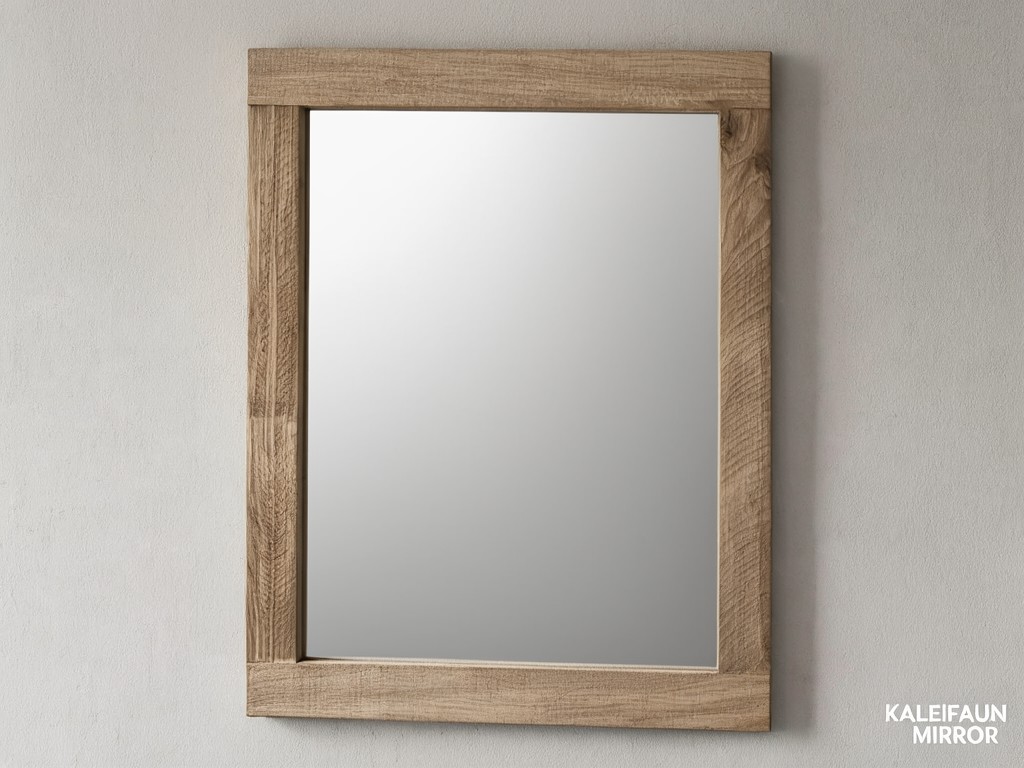
| Customization point | Typical order range or choice | Buyer detail to approve |
|---|---|---|
| Overall size | Common starting sizes include 300 × 400 mm, 400 × 600 mm, and 500 × 700 mm; bespoke dimensions by drawing. | State whether dimensions refer to the frame outside edge or visible mirror area. |
| Frame face and depth | A 25–60 mm face and 18–35 mm depth are common design ranges; profile shape affects the usable glass opening. | Approve a cross-section drawing where a narrow edge or deep profile matters. |
| Mirror glass | 3–5 mm glass is a common specification range, subject to size and frame construction. | Confirm thickness, edge treatment, visible area, and how the glass is retained. |
| Finish and branding | Specify stain or paint colour, sheen, natural grain variation, label placement, and any logo application. | Provide a colour reference and production-ready artwork where branding is required. |
| Weight and packing | Final net and packed weights depend on glass size, frame profile, hardware, and carton protection. | Request packed dimensions and weight for landed-cost planning and shelf handling. |
Buying Mistakes That Lead to Returns
Returns often trace back to a mismatch between the approved sample and the words on the purchase order. “Natural wood,” “organic shape,” and “ready to hang” leave too much room for interpretation. A retail buyer may expect a uniform colour, while the factory reads the phrase as permission for visible grain and tone variation.
- Use a dimensioned outline and identify the measuring points for asymmetrical frames.
- Approve finish samples under consistent lighting; note the acceptable range for grain, stain tone, and sheen.
- Specify glass thickness, edge finish, retention method, and the intended hanging orientation.
- Ask for the complete packed unit sample when transit damage or retail-ready presentation affects the selling cost.
- Put wood-origin claims and any documentation requirement in the order specification rather than relying on a product description.
A signed sample should represent the frame, glass, hanging parts, finish, labels, and packaging—not just the front appearance. If one part changes after approval, record the revision so a repeat order does not inherit an outdated specification.
Care, Storage and Service Life
Damp storage and direct contact with water can mark a wood finish or affect exposed edges. Keep cartons dry, off the floor, and away from sharp temperature changes before distribution. At retail or in the home, use a soft cloth on the frame and keep cleaning liquid off the wood joints and mirror backing.
For a longer service life, match the hanging hardware to the finished mirror weight and the intended wall type. The included fitting is not a substitute for suitable wall anchors; installation instructions should tell the end user to select fixings for the wall material.
Carton protection should prevent movement at the glass edges and keep the frame from taking point loads at its curves. For export orders, confirm whether the buyer needs individual retail cartons, outer cartons, protective corner pieces, or specific shipping marks. These details affect both damage exposure and the usable cost per unit sold.
Quotation Review for Wholesale and OEM Orders
Send the target dimensions, profile drawing or reference image, finish sample, glass specification, hanging requirements, order quantity, branding artwork, and destination packaging details for a comparable quotation. A complete specification makes it easier to compare unit price against expected returns, replacement freight, and retail handling cost.
For a quotation review, share the current product brief and the points that have caused complaints or returns. Contact the factory team to confirm the build, sampling requirements, packaging plan, and order pricing.