best price large rectangle wall mirrors for living room vendor: What Buyers Should Check Before Ordering
A large rectangular mirror can anchor a living-room wall, but a clean sample does not guarantee a clean installation. Buyers qualifying a second source should compare edge finish, backing protection, frame rigidity and mounting details—not just the glass price. Small differences in these parts can become cracked corners, dark spots behind the mirror or an expensive replacement shipment.
What Actually Determines Performance
Deflection under load governs whether a large mirror stays supported without stress at its edges. A wall fixing must suit the combined mirror and frame weight as well as the wall substrate; a mounting point that shifts or pulls out can put pressure on the glass and damage a corner. Confirm the hanging method, fixing locations and total packed-unit weight before approving a production sample.
Complaints also follow predictable use conditions. Sunlight through a window, household cleaners and rough wiping can expose weak backing protection or a surface that scratches too easily. The table connects those conditions to checks buyers can request from a vendor. Exact minimum order quantity and lead time depend on the selected size, frame, finish and export packing; confirm both against the final specification.
| Living-room use condition | Complaint or failure to prevent | Prevention specification and order check |
|---|---|---|
| Placement near a bright window, with routine dusting and occasional glass cleaning | Backing deterioration, edge discoloration or surface scratches | Specify mirror backing and protective paint system; approve a sample and cleaning guidance. Confirm whether the chosen backing option changes MOQ or production timing. |
| Repeated handling during delivery, unboxing and wall installation | Chipped edges, cracked corners or frame movement | Set edge polish, corner protection and fixing details before the packing trial. Oversize formats or crate packing may affect MOQ and lead time. |
| Wall mounting on different substrates or across repeated retail installations | A loose hanger, uneven seating or point pressure on the glass | Record the mirror’s finished weight, hanger position and intended fixing method. Keep these details consistent in the approved production drawing and repeat orders. |
Material Options and Their Trade-offs
Consistency depends on the glass, reflective layer and protective backing being specified together. A lower quote may use a standard mirror grade or a simpler frame; the saving only makes sense if the reflection, edge appearance and mounting method still match the retail requirement.
Mirror Glass and Backing
Standard silvered mirror is the common price-led choice for living-room use. Where a more neutral reflection matters, low-iron glass can reduce the green cast visible at the edges, but it raises material cost. Ask the vendor to identify the reflective coating and backing protection, and inspect the rear surface for uniform coverage and handling damage.
Frame and Edge Finish
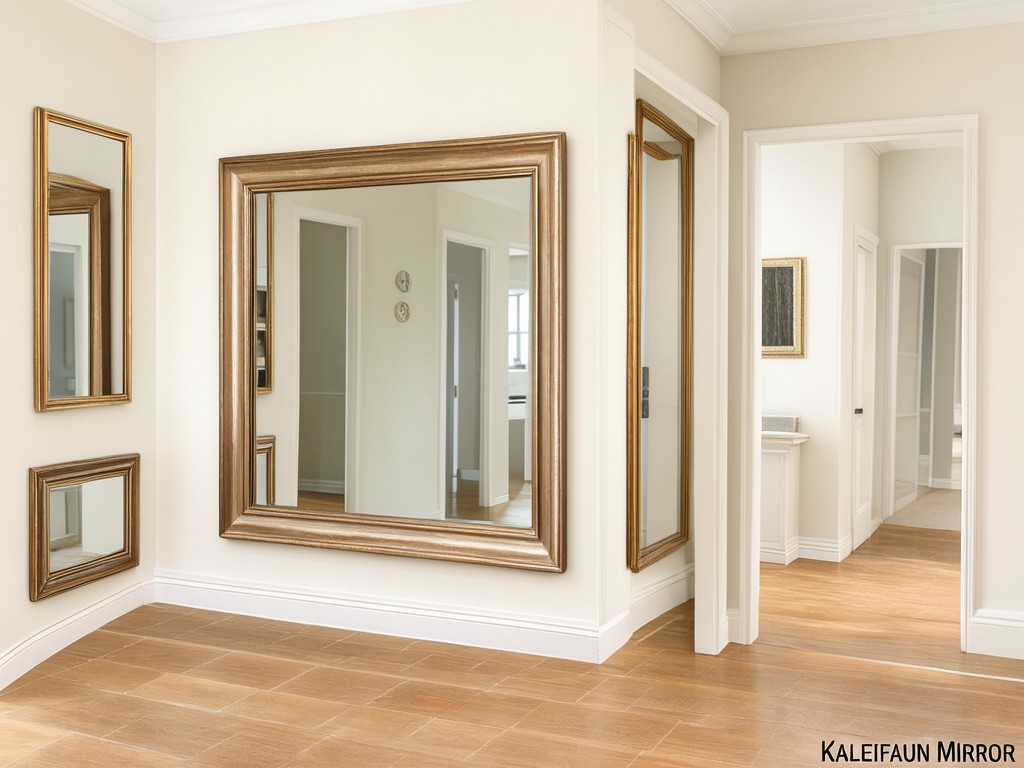
A metal frame can provide a slim profile; a wood frame offers a different visual finish and may add weight. Both need consistent corner joints and a secure connection to the mirror. Compare polished or seamed glass edges, frame finish and hanger attachment on the actual approved sample, since a frame can conceal edge quality without correcting poor support.
Safety backing can help retain fragments if glass breaks, but it does not replace suitable wall fixings or careful installation. Confirm the backing construction and its position in the assembly rather than treating a label or film claim as a substitute for a mounting review.
Size, Weight and Specification Range
The interface between parts determines how a large mirror handles transport and installation: glass thickness, frame depth, hanger position and carton clearance all affect the finished unit. Common living-room sizes range from around 600 × 1200 mm to 900 × 1800 mm, with other dimensions available by quotation. Treat these as indicative formats, not fixed catalog limits.
For glass alone, a useful estimating basis is approximately 10 kg/m² at 4 mm thickness, 12.5 kg/m² at 5 mm and 15 kg/m² at 6 mm. Frame, backing and hardware add weight. Request the finished dimensions and net weight for each SKU, plus a drawing that identifies glass thickness, edge treatment, frame section, hanging points and packing dimensions. These details help a second supplier reproduce the item without relying on visual comparison alone.
Quote against the complete assembly. Ask for mirror size, overall size, glass thickness, frame material, finished weight, hanger layout and carton or crate dimensions as separate line items. A glass-only price does not show the cost of the frame, mounting hardware or freight protection.
How to Choose Before Requesting a Quote
For a second-source review, compare the parts that affect repeat orders as well as the first-unit price. A vendor should be able to work from a controlled drawing, match an approved finish and explain how packing changes for the largest size in the order.
- Share target dimensions, acceptable size tolerances, mirror grade, edge finish, frame material and finish.
- Specify the intended wall-mounting arrangement and ask for hanger locations, finished weight and installation hardware details.
- Request a production sample or approval sample that shows the reflection, edge, frame joints, backing and protective packing.
- Ask the vendor to quote MOQ and lead time by size and configuration, including sample approval, packaging and any crate requirement.
- Agree on incoming checks for dimensions, weight, finish, hanger position and visible damage, then use the same checks for repeat lots.
Keep a signed sample or approved reference record for finish and assembly. If a later shipment differs, the drawing and inspection points give both buyer and vendor a concrete basis for resolving the gap.
Care, Storage and Service Life
Dust with a soft, clean cloth and use a mirror-safe cleaner sparingly. Keep liquid away from the edges and rear backing; trapped moisture can contribute to dark spots or backing damage. Avoid abrasive pads, gritty cloths and harsh cleaners, including bleach-based products, unless the vendor confirms compatibility with the specified finish.
Store mirrors upright in their designed protective packaging on a stable surface, with separators between units. Do not place heavy cartons against the glass or leave an unpacked mirror where it can twist or take a corner impact. During installation, use fixings suited to the wall and the mirror’s finished weight; inspect hangers and frame joints before the glass is lifted into place.
Service life depends on the backing remaining dry, the frame retaining its shape and the mounting remaining secure. For a second-source project, request a tooling and assembly review before bulk production so the supplier can check the frame profile, glass size, hanger positions and protective packing against your reference product.
Need to qualify an alternate production source? Request a tooling and specification review with your target sizes, frame details, annual volume and packing requirements.