Wholesale Decorative Vintage Bathroom Mirror Supplier - Bulk Supply and Specification Guide
What Actually Determines Performance
The interface between parts determines whether a vintage-style mirror stays presentable in daily bathroom use: glass edges meet the backing, the backing meets the frame, and the frame carries the wall load. A decorative profile can hide those junctions, but it cannot compensate for exposed silvering, loose corner joints, or an unsuitable hanging system.
For a second-source review, assess the assembly as well as the finish. A typical process cuts and edge-finishes the mirror glass, applies the reflective and protective backing, then fits the glass into a finished wood, engineered-wood, or metal frame. Sealed edges and secure retainers help limit moisture intrusion; a stable frame and correctly positioned hangers reduce stress during installation. The trade-off is direct: a lower-cost frame may suit a dry powder room, while a better-sealed construction can reduce edge deterioration and warranty claims in bathrooms with frequent steam exposure.
Inspection Standards and Complaint Prevention
| Bathroom Use Condition | Complaint or Failure Seen | Specification and Factory Check |
|---|---|---|
| Repeated steam exposure and routine wipe-downs | Dark spots or edge corrosion beneath the reflective layer | Specify protected mirror edges and a sealed frame interface; inspect backing coverage and exposed edge areas before assembly. |
| Close-up grooming under direct lighting | Visible waviness, distortion, or surface marks | Lock the glass thickness and approved viewing criteria; check the reflective face under diffuse and angled light. |
| Wall installation with frequent repositioning during fitting | Loose hangers, frame racking, or cracked corner joints | Set hanger type and location against the finished unit weight; check frame dimensions, joint closure, and fixing security. |
| Parcel or pallet transit with frame corners exposed | Chipped corners, cracked glass, or scuffed aged-effect finish | Approve corner protection and glass restraint in the export pack; inspect a packed sample before the production lot ships. |
Size, Weight and Specification Range
Balance and load analysis shows why the overall outline alone is not enough for a quotation. Glass thickness, frame depth, moulding material, and hanger placement all affect finished weight and wall clearance. As a planning guide, framed formats from about 400 × 600 mm to 900 × 1,200 mm are common order discussions; a 4–5 mm mirror is a typical starting range, subject to size, frame support, and the buyer’s drawing.
Finished weight varies substantially by frame profile. Smaller formats may fall around 4–7 kg, while larger framed units can reach approximately 13–20 kg. Treat these as freight and hanger-planning estimates, not fixed product tolerances. Confirm the final dimensions, net weight, carton size, and hardware position against the approved sample before setting a purchase order or retail listing.
Specification rule: keep the mirror outline, frame projection, hanger position, and finished weight on one controlled drawing. If any of these changes after sample approval, recheck wall clearance, carton fit, and the stated hanging method before batch release.
Option Comparison by Usage Level
Choose the frame construction to match the retail price point and expected bathroom exposure. The finish name alone does not define service life: edge sealing, joinery, and care instructions determine whether a distressed or aged appearance remains controlled after installation.
Value Retail: Engineered-Wood Frame
A routed MDF or similar engineered-wood profile supports repeatable shapes and painted vintage effects at a controlled unit cost. This option suits coordinated bathroom ranges where the silhouette and colour need to match across multiple sizes.
Specify sealed edges and a finish system suited to the intended room exposure. It is less suitable for buyers who require a natural timber grain or frequent wet cleaning near an exposed frame edge.
Higher Price Point: Solid Wood or Metal Frame
Solid wood offers visible grain and a more individual aged finish; metal supports narrower profiles and can suit a painted, patinated, or darkened look. Both options may raise material, finishing, and packing costs compared with a moulded engineered-wood frame.
Use these constructions where the finish is a principal selling feature or the range needs a distinct material story. Agree the allowable variation in grain, colour, or patina with the approved reference sample.
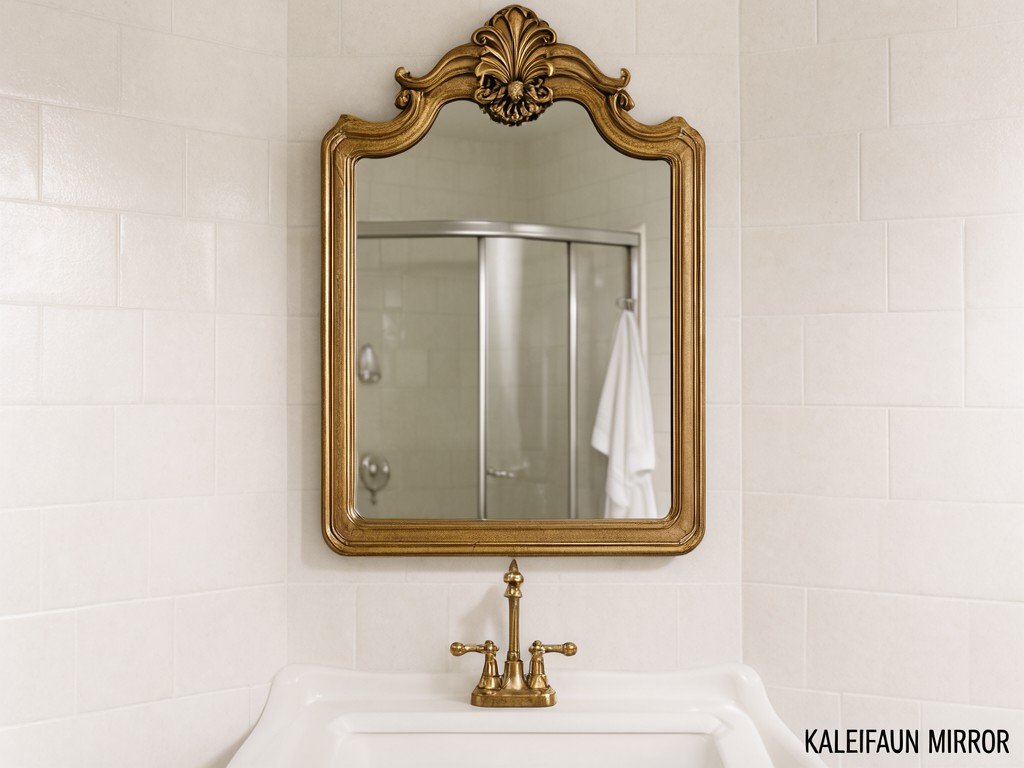
Working as a Production Partner, Not a Catalogue Supplier
A second source should be able to reproduce the approved frame profile, glass size, finish character, and packing method—not just offer a similar photograph. For OEM and private-label programs, begin with a dimensioned drawing or physical reference, then record the glass, frame material, finish, hardware, label, and carton requirements in one controlled specification.
Customization can use existing frame tooling or a new profile. Existing tooling usually reduces setup time and initial cost, while a new profile gives the buyer more control over the vintage silhouette but may require tooling approval and a longer sample cycle. Artwork should be supplied as print-ready files for labels or inserts; branded cartons need review for size, language, and handling marks before production.
Customization Options
| Buyer-Controlled Item | Available Specification Direction | Approval Point |
|---|---|---|
| Mirror and frame dimensions | Custom outline, nominal size, frame width, depth, and corner profile | Signed drawing and first-article measurement record |
| Vintage finish and colour | Painted, stained, distressed, or metal-effect finish; variation limits set by reference sample | Approved physical swatch or signed sample under agreed viewing conditions |
| Hanging hardware and rear construction | Hanger type and position, rear board, glass retention, and installation instructions | Finished-unit weight and fixing arrangement confirmed on the sample |
| Private-label retail and export pack | Product labels, instruction insert, protective corners, carton print, and pack quantity | Artwork proof and packed sample checked against destination-market requirements |
Tooling, finish matching, and custom packaging can affect minimum order quantity and lead time. Ask for those costs as separate quotation lines so the unit-price comparison includes setup, sample approval, replacement hardware, and freight protection.
How Consistency Is Held Across Batches
Consistency depends on controlled references and repeatable checks, not on a verbal description such as “antique gold” or “distressed white.” Keep one approved sample and a written finish tolerance for production comparison. Record the glass size, frame dimensions, hanger location, finish batch, and carton configuration against the order so a repeat lot can be compared with the same reference.
- Measure frame and mirror dimensions at agreed checkpoints; segregate units that fall outside the approved drawing.
- Review the mirror face and silvered edges under consistent lighting for scratches, spots, exposed backing, and visible distortion.
- Check finish colour and distress pattern against the retained sample, with any acceptable natural variation stated before the order starts.
- Inspect frame joints, glass retention, and hanger security on assembled units; review packed samples for corner protection and movement inside the carton.
- Maintain lot identification on production and packing records so a claim can be traced to the relevant materials and process checks.
The lowest unit price is not the lowest landed cost if glass breakage, finish mismatch, or edge corrosion drives returns. Compare the quotation with expected packing needs, spare hardware availability, inspection scope, and agreed warranty handling. For a second-source qualification, request the drawing, sample plan, batch inspection record format, and a written process for handling nonconforming units before placing the first bulk order.
Request a quotation review
Send the target sizes, frame material and finish reference, glass specification, estimated order quantity, and destination packaging needs. A side-by-side review can identify sample, tooling, inspection, and freight-protection costs before you qualify a second source.
Share your mirror specification for quotation